
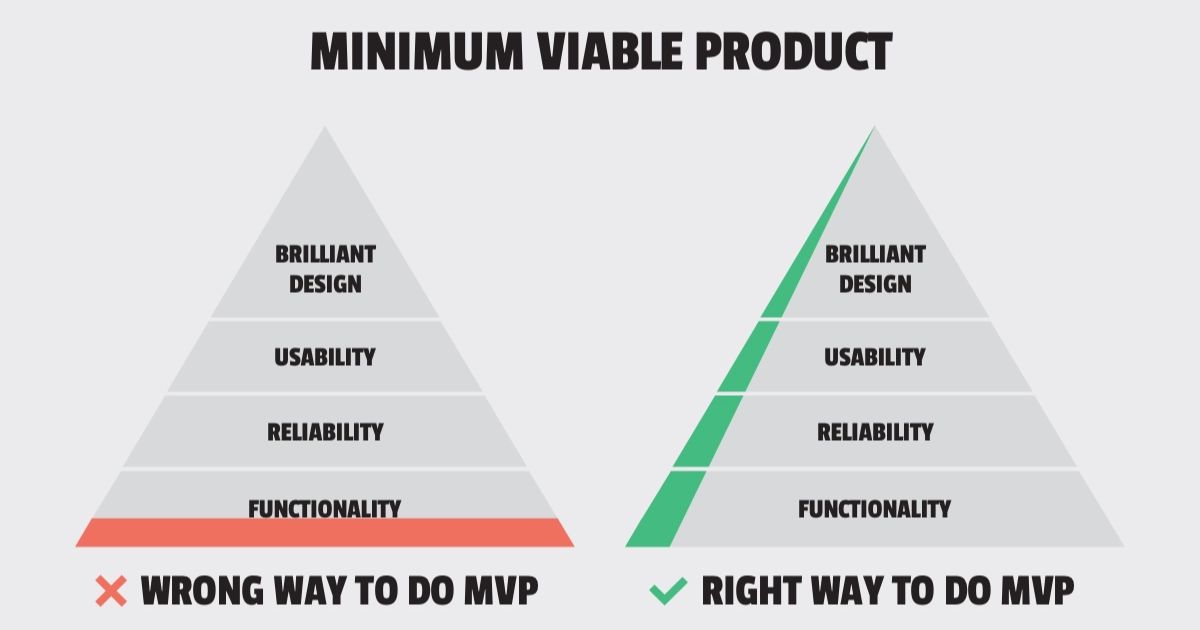
Building a minimum viable product should help a startup test an idea before committing significant time, money, and resources. However, many founders misunderstand what an MVP is supposed to achieve. They treat it as a smaller version of the final product, rush into development, add unnecessary features, and launch without clearly defined success metrics. The product may reach the market, but it fails to generate useful evidence about customer demand.
That is the real reason many MVPs fail. An MVP is not simply the cheapest or fastest product a team can release. It is the smallest credible experiment that can test a critical business assumption with real users.
When an MVP is built around learning rather than launching, it can help a startup:
- Validate whether a meaningful problem exists
- Test whether customers want the proposed solution
- Identify which features create genuine value
- Measure willingness to use or pay for the product
- Reduce financial and technical risk
- Create evidence for investors and stakeholders
- Decide whether to continue, pivot, or stop
This guide explains why MVPs fail, how to recognize the warning signs, and what founders can do differently.
What Does MVP Failure Actually Mean?
An MVP has not necessarily failed because it attracted fewer users than expected. Early-stage products are designed to test assumptions, not achieve immediate mass adoption. A true MVP failure occurs when the startup spends its budget but learns little about the market.
An MVP may be considered unsuccessful when:
- The product does not test a clear hypothesis
- Users reject its core value proposition
- The team cannot interpret the results
- Development costs increase without useful validation
- Major parts of the product must be rebuilt
- The startup runs out of money before reaching product-market fit
- The team continues development despite consistently negative evidence
A useful way to evaluate an MVP is to ask:
Did the product produce enough evidence to guide the next business decision?
Even a product that users reject can generate valuable learning. However, an MVP that launches without clear assumptions, metrics, or feedback systems may teach the team almost nothing.
What Our Internal MVP Analysis Suggests
Based on Phenomenon Studio’s internal review of 28 MVP launches and 83 failed or struggling MVPs, validation discipline appeared to matter more than speed or technological sophistication.
The internal analysis suggested that:
- MVPs launched in less than six weeks experienced a higher failure rate when discovery and user research were skipped.
- Products developed within a more balanced timeline performed better when proper validation was completed before coding.
- Many failed MVPs contained features that users had never requested.
- Clear hypotheses showed a stronger relationship with positive outcomes than complex technology choices.
- Products with predetermined success metrics were more likely to remain active after launch.
These figures represent Phenomenon Studio’s project portfolio and should not be treated as universal industry benchmarks. However, they highlight a pattern that founders should not ignore: launching quickly is not useful when the team is building on untested assumptions.
The MVP Solves an Unvalidated Problem
One of the most common reasons MVPs fail is that the startup develops a solution before confirming that the problem is important enough. Founders often become emotionally attached to an idea. They assume that because the problem appears meaningful to them, customers will automatically care about it too.
However, users may:
- Experience the problem infrequently
- Consider the issue too minor to solve
- Already have an acceptable alternative
- Be unwilling to change their current behavior
- Like the idea but remain unwilling to pay for it
How to avoid this mistake
Conduct problem-focused research before discussing your proposed solution.
Ask target users:
- How do you currently handle this problem?
- How frequently does it occur?
- What does the problem cost in time, money, or frustration?
- What solutions have you already tried?
- Why were those solutions inadequate?
- How important is solving the problem right now?
Do not ask, “Would you use my product?” People frequently give polite or hypothetical answers. Instead, examine their current actions, expenses, frustrations, and priorities.
The Target Audience Is Too Broad
An MVP cannot effectively serve everyone.
Products often fail because founders define their audience using vague descriptions such as:
- Small businesses
- Online shoppers
- Healthcare professionals
- Fitness enthusiasts
- People who want to save money
These groups contain users with very different problems, motivations, budgets, and buying behaviors.
When the target audience is too broad, the value proposition becomes generic. Marketing becomes expensive, product decisions become inconsistent, and user feedback becomes difficult to interpret.
How to avoid this mistake
Define a narrow early-adopter segment.
Instead of targeting “small businesses,” focus on something more specific, such as:
Independent dental practices in the United States that manually manage patient follow-up appointments.
A focused audience makes it easier to:
- Understand user pain points
- Recruit research participants
- Design relevant features
- Write stronger marketing messages
- Select effective acquisition channels
- Interpret product usage data
The audience can expand after the initial problem and solution have been validated.
3. The Team Builds a Miniature Final Product
A common misunderstanding is that an MVP should be a reduced version of the founder’s complete vision. This mindset usually produces a long feature list covering accounts, dashboards, notifications, integrations, reports, administration tools, and advanced settings.
The result may be smaller than the planned final product, but it is not necessarily a meaningful MVP.
A strong MVP should be designed around one important question, such as:
- Will users complete this workflow?
- Will customers pay for this outcome?
- Can the product reduce a specific task from three hours to 30 minutes?
- Will buyers and sellers successfully complete transactions?
- Will users return after receiving the initial value?
How to avoid this mistake
Identify the riskiest assumption in the business model. The riskiest assumption is the belief that would make the entire idea unworkable if proven wrong. Build only what is required to test that assumption convincingly. Features that do not support the experiment should be moved to a future backlog.
4. The MVP Tests Too Many Assumptions at Once
Some startups attempt to validate the problem, audience, price, technology, user experience, acquisition strategy, and revenue model through one launch. This creates unclear results.
When adoption is weak, the team cannot determine whether the problem was caused by:
- The wrong audience
- Weak positioning
- Poor onboarding
- Missing functionality
- Incorrect pricing
- Technical bugs
- Ineffective marketing
- Limited demand
An experiment that changes too many variables rarely produces a clear conclusion.
How to avoid this mistake
Create an assumption map before development.
List all major assumptions and rank each one according to:
- Risk: How likely is the assumption to be wrong?
- Impact: How damaging would it be if the assumption were wrong?
- Evidence: What information currently supports it?
- Testability: How quickly can the assumption be tested?
Begin with the highest-risk, highest-impact assumption.
5. The Feature Scope Is Incorrect
MVP failure can result from both excessive and insufficient functionality.
Too many features
Feature overload increases:
- Development time
- Project cost
- Testing requirements
- Technical complexity
- User confusion
- Difficulty identifying what creates value
Too few features
An overly limited product may not provide enough value for a realistic test.
For example, an investment platform without automated data imports may appear minimal from a development perspective. However, if users consider manual data entry unacceptable, the product cannot properly validate demand.
How to avoid this mistake
Do not ask, “What is the smallest feature set we can build?”
Ask:
What is the minimum functionality required for a target user to experience the promised value?
Prioritize a complete core journey rather than several incomplete features.
The MVP should enable a user to move from the initial problem to a meaningful outcome without unnecessary friction.
6. The Product Is Launched Too Early
Startup culture often celebrates speed. Speed can be helpful, but premature launching can damage an otherwise promising idea.
A rushed MVP may suffer from:
- Weak problem validation
- Incomplete user journeys
- Broken functionality
- Confusing onboarding
- Missing analytics
- Poor first impressions
- No measurable success criteria
Launching quickly does not guarantee faster learning. A half-finished product may only confirm that users dislike confusing or unreliable software.
How to avoid this mistake
Balance speed with preparation.
Before public launch, confirm that:
- The core problem has been researched
- The target audience is clearly defined
- The main hypothesis is documented
- The essential workflow functions correctly
- Analytics are installed
- Feedback channels are available
- Critical bugs have been resolved
- Success and failure thresholds are defined
An MVP does not need to be perfect. It does need to be credible enough for users to evaluate its core value.
7. The Product Is Overengineered
Some development teams create complex infrastructure before market demand has been validated.
They may build:
- Enterprise-level architecture
- Advanced permissions
- Multi-region infrastructure
- Complex automation
- Extensive third-party integrations
- Sophisticated administrative systems
- Scalability for millions of hypothetical users
This increases cost and delays the learning process.
Scalability matters, but premature scalability can become an expensive distraction.
How to avoid this mistake
Select technology based on the experiment, not on what appears most impressive.
No-code, low-code, manual operations, or lightweight custom development may be sufficient when the goal is to validate demand.
Custom development becomes more important when:
- Proprietary technology is the main value proposition
- Complex data processing is essential
- Security requirements cannot be met by standard tools
- Real-time functionality is necessary for validation
- Existing platforms cannot reproduce the required user experience
Build for the evidence you need today while avoiding decisions that make future iteration unnecessarily difficult.
8. The User Experience Delays the Core Value
Users should quickly understand:
- What the product does
- Who it is designed for
- What problem it solves
- What action they should take
- What outcome they will receive
When onboarding is confusing or the product requires too many steps before delivering value, users leave before properly experiencing the solution.
This can produce misleading results. The team may conclude that customers do not want the product when the actual problem is that customers cannot reach its value.
How to avoid this mistake
Measure time to value.
Time to value is the amount of time required for a new user to experience the first meaningful benefit.
Reduce unnecessary:
- Form fields
- Setup steps
- Navigation options
- Permissions
- Instructions
- Decisions
- Account requirements
Test the complete onboarding journey with users who have never seen the product before.
9. Success Metrics Are Not Defined Before Launch
Many founders launch an MVP and decide later whether it performed well. This creates biased interpretation. Positive numbers are celebrated, while negative signals are explained away. Downloads, traffic, and registrations may look encouraging, but they do not always prove that the product creates lasting value.
How to avoid this mistake
Define measurable success criteria before development is completed. An MVP measurement framework should contain four elements.
Primary hypothesis metric
This is the main result that proves or disproves the central assumption.
Examples include:
- Percentage of trial users who become paying customers
- Percentage of users who complete the core workflow
- Number of sellers who complete their first transaction
- Percentage of users who return after seven or 30 days
Leading indicators
These are early behaviors that suggest whether the product is moving toward success.
Examples include:
- Onboarding completion
- Feature adoption
- Time to first value
- Daily or weekly active usage
- Core task completion
- User invitation rate
Qualitative feedback
Analytics show what users do. Interviews help explain why they do it. Schedule user conversations throughout the testing period. Ask about the problem, expected outcome, confusing steps, missing functionality, and reasons for continued or discontinued usage.
Falsification criteria
Determine which result would prove that the hypothesis is wrong.
For example:
If fewer than 20% of qualified users complete the core workflow after four weeks, we will review the problem, audience, onboarding, and proposed value before adding new features.
Failure criteria prevent teams from continuing indefinitely without credible evidence.
10. Feedback Loops Are Weak or Nonexistent
Launching an MVP is the beginning of the learning process, not the end. Some teams release the product, collect a few comments, and immediately begin building their original roadmap. As a result, the MVP becomes a formality rather than a decision-making system.
Feedback must be collected, organized, and connected to observable user behavior.
How to avoid this mistake
Create a structured feedback process that includes:
- Product analytics
- Session recordings where appropriate
- Support requests
- Cancellation reasons
- User interviews
- In-product surveys
- Sales conversations
- Feature usage reports
- Onboarding drop-off analysis
Do not implement every user request. Look for repeated patterns connected to the core problem. A single request may represent an individual preference. Repeated behavior across several users may indicate a genuine product opportunity.
11. The Development Team Does Not Understand MVP Strategy
Technical competence alone does not guarantee successful MVP development. A team may write excellent code while still building the wrong product. MVP development requires a combination of:
- Product thinking
- Business understanding
- User research
- UX design
- Technical judgment
- Analytics planning
- Rapid iteration
- Honest communication
A development partner who simply accepts every requested feature may increase the risk of failure.
How to avoid this mistake
Evaluate potential MVP developers by asking:
- How do you validate assumptions before coding?
- How do you prioritize MVP features?
- How do you define success metrics?
- What happens when research contradicts the founder’s original idea?
- How do you balance speed with code quality?
- How do you handle technical debt?
- What analytics and feedback systems do you recommend?
- How do you support post-launch iteration?
The right team should challenge weak assumptions, not merely execute a feature list.
12. There Is No Distribution Strategy
A functional product cannot generate meaningful validation when the right users never discover it.
Some founders focus almost entirely on development and postpone marketing until launch. They then release the MVP without:
- A beta-user list
- Customer interview participants
- Relevant communities
- Outreach campaigns
- Partnerships
- Paid acquisition tests
- Search visibility
- Referral mechanisms
Low adoption may then be mistaken for low market demand.
How to avoid this mistake
Develop the distribution strategy alongside the product.
Before launch, identify:
- Where the target audience already spends time
- Which channels can reach early adopters
- How many users are required for meaningful validation
- How users will be recruited
- What message will attract qualified participants
- What incentive, if any, will encourage participation
A good MVP does not need thousands of random visitors. It needs enough relevant users to produce reliable evidence.
Failed MVP Approach vs Validation-Focused Approach
| Failed MVP Approach | Validation-Focused Approach |
|---|---|
| Begins with a large feature list | Begins with assumptions and risks |
| Targets a broad market | Focuses on a specific early-adopter segment |
| Optimizes for fastest possible launch | Optimizes for fastest credible learning |
| Uses internal opinions as evidence | Uses interviews, behavior, and market data |
| Builds what is easiest technically | Builds what is essential for validation |
| Measures downloads and traffic | Measures value, retention, and conversion |
| Treats launch as completion | Treats launch as the beginning of iteration |
| Adds features after weak adoption | Investigates the reason behind weak adoption |
| Chooses technology for prestige | Chooses technology for validation needs |
| Avoids negative evidence | Defines conditions that may disprove the idea |
A Better MVP Development Process
At Phenomenon Studio, a validation-focused MVP process can be organized into seven stages.
Phase 1: Assumption Mapping
Document the beliefs behind the product, audience, pricing, distribution, technology, and business model.
Rank each assumption according to risk and impact.
Phase 2: User Research
Interview people who genuinely match the target customer profile.
Explore their current behavior before presenting the proposed product.
Phase 3: Hypothesis Definition
Turn the riskiest assumption into a clear statement that can be tested.
For example:
Compliance managers will pay for automated reporting if the product saves at least three hours of manual work each week.
Phase 4: Success Metric Planning
Define the primary metric, supporting indicators, qualitative research plan, and failure threshold.
Do this before the product is launched.
Phase 5: Focused MVP Design
Design the smallest complete journey that allows users to experience the proposed value.
Remove features that do not support the central experiment.
Phase 6: Development and Pre-Launch Testing
Use the most appropriate technology for the validation goal.
Test the product with a small group of representative users before a wider launch.
Phase 7: Launch, Measure, and Iterate
Observe behavior, conduct interviews, compare results against the predetermined criteria, and decide whether to:
- Continue
- Improve
- Reposition
- Change the audience
- Pivot the solution
- Stop development
The purpose of the MVP is not to prove that the founder was right. Its purpose is to reveal what the business should do next.
How to Know Whether Your MVP Is Working
Your MVP may be moving in the right direction when:
- Users understand the value without extensive explanation
- A meaningful percentage completes the core workflow
- Users return to repeat the important action
- Customers recommend the product to relevant people
- Users show willingness to pay
- Feedback becomes more specific and less fundamental
- Retention improves after targeted iterations
- Acquisition channels produce qualified users
- The product solves the intended problem measurably
Be cautious when growth depends entirely on discounts, personal relationships, or constant founder involvement. These may help during early validation, but the business should eventually demonstrate repeatable value.
Pre-Launch MVP Checklist
Before launching, confirm that you can answer the following questions:
- What exact problem are we testing?
- Who experiences this problem most strongly?
- What evidence confirms that the problem matters?
- What is our riskiest assumption?
- What user action will test that assumption?
- What is the minimum complete workflow?
- Which features have been intentionally postponed?
- How will we recruit relevant users?
- What analytics have been installed?
- What metric defines success?
- What outcome would disprove the hypothesis?
- When will the results be reviewed?
- Who will decide whether to continue, pivot, or stop?
When these questions do not have clear answers, the product may not be ready for development or launch.
Final Thoughts
Most MVPs do not fail because founders lack ambition or developers lack technical skill. They fail because the product is built around assumptions that were never properly tested.
Successful MVP development requires disciplined focus. Start with a real problem. Narrow the target audience. Identify the riskiest assumption. Build the minimum experience required to test it. Define success before launching. Collect both behavioral data and direct user feedback. Then allow the evidence to guide the next decision.
Speed remains valuable, but only when it shortens the path to credible learning. Launching a weak product in four weeks is not necessarily better than launching a focused, testable MVP in ten or twelve weeks. Speed to failure is still failure. The goal is to reach useful evidence before the startup exhausts its resources.
Phenomenon Studio helps startups plan, design, develop, and validate focused MVPs. Our process combines product strategy, user research, UX design, technical development, analytics, and post-launch iteration to help founders reduce uncertainty before scaling.
Frequently Asked Questions
Why do most MVPs fail?
Most MVPs fail because they solve an unvalidated problem, target the wrong audience, include an incorrect feature set, or launch without clear success metrics. Technical problems can contribute, but weak product strategy is often the more fundamental issue.
What is the biggest mistake when building an MVP?
The biggest mistake is treating an MVP as a smaller final product instead of an experiment. A useful MVP should test one important business assumption and generate evidence that guides the next decision.
How many features should an MVP include?
There is no universal number. An MVP should include the minimum functionality required for a target user to complete the core journey and experience the promised value. Every feature should support the main validation hypothesis.
How long should MVP development take?
The correct timeline depends on the product, technical complexity, regulatory requirements, integrations, and validation method. The goal should not be the shortest possible timeline. It should be the shortest timeline that allows credible research, development, testing, and measurement.
Can a no-code product be a real MVP?
Yes. No-code and low-code tools can be effective when they reproduce the experience required to test demand. Custom development is more appropriate when proprietary technology, complex integrations, security, or real-time processing are essential to the core value proposition.
How do you measure MVP success?
MVP success should be measured using a predetermined primary hypothesis metric, leading indicators, retention or conversion data, and qualitative user feedback. Downloads and registrations alone rarely provide enough evidence.
Should an MVP be scalable from the beginning?
An MVP should be stable and maintainable, but it does not always need enterprise-level scalability. Premature infrastructure can waste resources. The architecture should support expected validation usage and allow reasonable iteration without unnecessary complexity.
What should happen after an MVP launch?
After launch, the team should analyze user behavior, interview participants, identify friction points, compare results with success criteria, and decide whether to improve, pivot, scale, or discontinue the product.